I. Stakes
An FTC season is two races run in parallel: build a competition robot before the qualifier window closes, and raise the money that keeps the team entered at all. FTC teams that don't fundraise don't field robots. Since 2024 I have run both races for TeamTaro, as its Team Lead and Software Lead.
As engineer, I own the robot from frame to autonomous opmode and the software stack on Android Studio. As organizer, I run the weekly meetings, coordinate the build, code, and outreach subteams, lead the sponsor pitches, and write the season strategy document and the engineering portfolio submission. Neither job is optional.
Great robotics is a budgeting problem before it is an engineering one.
II. Decisions
Off-the-shelf where a part exists, printed where it doesn't
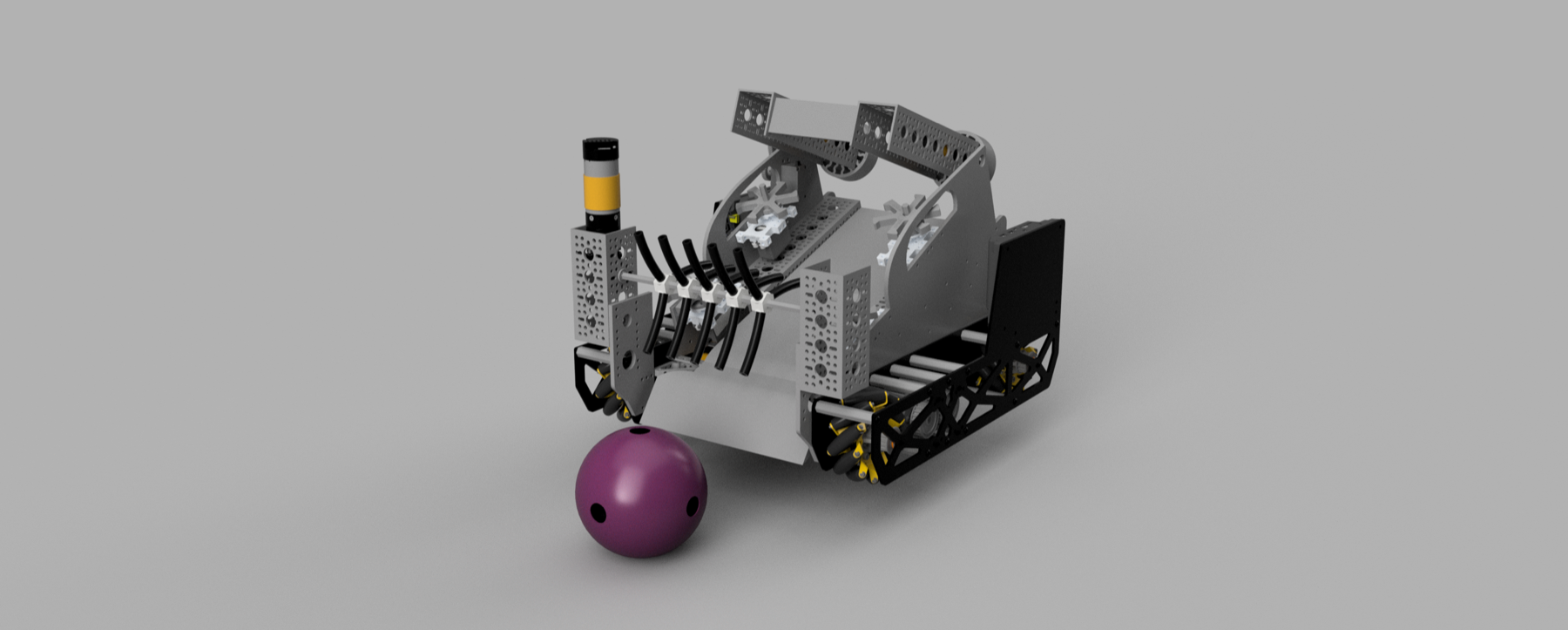
The robot is a 4-wheel mecanum chassis carrying a 2-stage vertical lift, a hinged depositor arm, and an active intake, modeled in Fusion 360 and run on the standard REV Control + Expansion Hub stack. Mecanum wheels trade pushing power for the ability to strafe, which is what lets a driver line up on a scoring target without surrendering cycle time. The fabrication rule was equally plain: goBILDA off-the-shelf hardware wherever a part exists, 3D-printed brackets where it doesn't, because a small team's scarcest resource is build hours.
- Drive4-wheel mecanum chassis
- Lift2-stage vertical lift
- DepositHinged depositor arm
- IntakeActive intake
- ControlREV Control + Expansion Hub
- CAD / FabFusion 360 · goBILDA + 3D-printed brackets
Build the codebase so rookies can ship
As Software Lead I architect the codebase: the Android Studio setup, the gamepad mapping, and the autonomous opmode framework. The framework is deliberately boring because its job is to be handed over. I pair-program with rookie members until they ship their own opmodes by mid-season.
Run funding like a subsystem
Outreach runs on the same cadence as build and code: a subteam, weekly meetings, owned deliverables. Across the season that meant four sponsor pitches, two community demo days, and a STEM workshop for younger students. You can design the perfect mechanism, but if the team folds in October because nobody raised the entry fee, none of it ships.
III. Results
The money result
$1,500 raised, and the team stayed in the season. For an FTC team, that is the result every other result depends on.
Small numbers, and I am not dressing them up. What they document is a team that stayed entered: two seasons in, funded, staffed, and fielding a robot.
The record is thinner than the work. No competition placement appears here because I have not put one on the record, and no photograph of the physical robot exists beyond the render in Fig. 01. Those are the honest gaps.